With college football changing as quickly as it is, Congress has taken it upon itself to try to regulate the sport with the Protect College Sports Act.
The bill proposed by a bipartisan few Congresspeople aims to fix many things they see as issues in college sports, putting regulations on things like NIL, recruiting and much more.
But the way the bill was written up at first is not how either Big Ten commissioner Tony Petitti or SEC commissioner Greg Sankey want the sport to look moving forward. Sankey went as far as saying that if the bill doesn’t get amended, his conference could consider breaking away from the NCAA.
Petitti had similar opinions about the bill in its current form, disagreeing with the way it approaches many different aspects of the game, starting with conference alignment and scheduling regulations that were proposed.
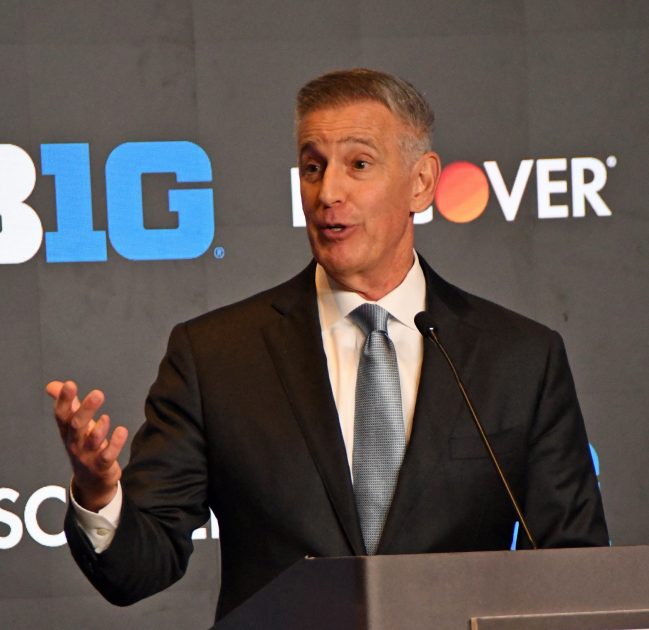
“I would divide the bill into the two sections that it’s in,” Petitti said. “So taking the second section first, which is really around the SBA, conference alignment, scheduling requirements, what you can do in third party involvement and the makeup of conferences — we feel really strongly that that language has to be right.”
The second part of the bill Petitti referred to attempts to make it so that any conference that reported a $1 billion revenue in the 2025 fiscal year cannot add another team to the conference.
Since the original bill, there have been rumors of changes that could be made to the specific language in that section, which Petitti and Sankey have likely had conversations about. Petitti said on Tuesday at Big Ten media days that, while he is fine with Congress getting involved in those types of transactions for conferences, he believes the language needs to be “right.”
With conferences expanding recently and adding more teams, and more rumors flying about other possible additions, Petitti wants to make sure the Big Ten has options going forward if it wants to add more teams to the 18-team league.
“We’ve been aligned with the SEC,” Petitti said. “If Congress is going to be involved in deciding who can be in which conference and when you move and how you move and how you schedule based on certain things happening, we just need to get that right.”
Another piece of the bill that Petitti touched on Tuesday is the recruiting section.
The bill attempts to counter tampering, not allowing schools to contact players who are enrolled at or committed to another program, which many coaches have said has been a problem with the transfer portal.
However, the language of “committed to another institution” could be taken in a way that means even high school recruits who commit to a school before signing day can’t be contacted, which the conferences may have a problem with.
It also attempts to regulate colleges “inducing a student athlete to enroll at an institution or transfer to an institution by offering compensation” that would violate regulations set elsewhere in the bill.
Petitti also seemed to be OK with regulations on recruiting, but wanted to make sure there are national standards that apply the same way to every school in the country rather than states each having different regulations, which would give some teams unfair advantages over others.
“What can states still be put in a position where they can enact recruiting laws that will make it uneven in terms of how we compete? We need national standards,” Petitti said. “We’ve been clear about that.”
Petitti was also asked about Sankey’s comments on the possibility of his conference breaking away from the NCAA at some point due to potential issues in the Protect College Sports Act, and Petitti downplayed the idea.
However, he did say that he believes there can be an agreement where the conferences regulate themselves in some way and rely on the College Sports Commission for some things as well.
He said that the first priority right now for the conferences is to try to get the language in the bill right, and the two commissioners are attempting to work with members of Congress to be able to do that. But if that doesn’t ultimately happen, relying on the CSC a little more is a possible solution for them.
“Is there a path to have rules that we can at least operate from the conference?” Petitti said. “That’s also really difficult. We absolutely have to do everything we can to prepare for every one of those things.
“The second path is going to be if we can’t get the Bill, can we come up with a system that improves CSC? I think all that work is going to be doing it together.
“If those things don’t happen, I think every league is going to be in the position to say, ‘What are we going to do better than what we have now? Do we have to do it ourselves?’ “
Petitti said multiple times that a break away from the NCAA wouldn’t mean the conferences would go their separate ways. He said that he wants the regulation of college football to be worked up in a way that the Big Ten can have big interconference matchups every season, more often than they do now.
He did mention that he knows it won’t be a perfect bill in terms of everything the Big Ten is going to ask for, but he is trying to get it to be as close to that as he can with whatever say he has as commissioner of the conference.
“We recognize it’s not going to be perfect for us in every one of those places, but at the end of the day, when the conference gets the Bill and we work through it, are we in a position where it does a lot more — it provides a lot more help than not,” Petitti said. “If we can get to that place, then we can move into a position very quickly to support it. But again, until I see where we are, we’re not quite ready to say that.”
Petitti said that he is in constant communication with Sankey about the proposed bill and that both commissioners have been working together to try to get the language right. They were on a Zoom call with the Senators who proposed the bill to discuss possible changes as well.
He hopes to see some changes made to the bill as soon as the day he spoke to media.
USA Today reported soon after Petitti spoke that the Senators are prepared to make “a dozen major concessions or revisions to the bill” that attempts to gain the support of both of the major conferences.
Conference expansion was one thing that was reported to be back on the table, allowing leagues to add up to as many as 19 members. John Brice of USA Today reported in his story that eight of the 12 concessions were said to be “full” concessions to the Big Ten and the SEC.
Petitti said that he understands there is likely a long way to go with the conversations about the bill, and he is expecting a lot of back and forth between the conferences and Congress.